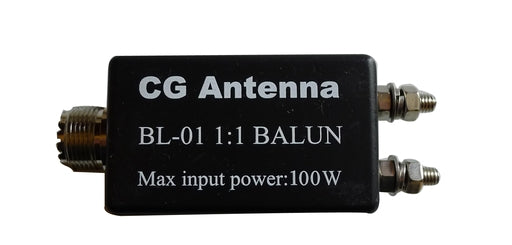
All about baluns and ununs
A good antenna system consists of more than just an antenna and a coaxial cable. In many installations, a balun or unun plays an important role in optimizing signal transmission and reducing unwanted interference. By correctly matching the impedance, you ensure that your transceiver and antenna work together optimally, resulting in better performance.
At Deltron, you will find a carefully selected range of baluns and ununs for various HF, VHF, and UHF applications.
What is a balun?
A balun (Balanced to Unbalanced) is a transformer that connects a balanced antenna system to an unbalanced transmission line, such as a coaxial cable.
A balun ensures that:
- The impedance is correctly matched
- Common mode currents are reduced
- Unwanted RF interference decreases
- The antenna can operate more efficiently
- Signal quality improves
Baluns are widely used with antennas such as:
- Dipole antennas
- Yagi antennas
- Loop antennas
- Other balanced antenna systems
What is an unun?
An unun (Unbalanced to Unbalanced) is used to match two unbalanced systems with different impedances.
An unun is widely used with:
- End-fed antennas
- Long Wire antennas
- Vertical HF antennas
- Random wire antennas
By correctly matching the impedance, energy is transferred more efficiently, and reflections and losses are reduced.
What is the difference between a balun and an unun?
Although both components are used for impedance matching, they have different functions.
Balun
A balun is used when a balanced antenna is connected to an unbalanced coaxial cable.
Common applications:
- Dipoles
- Yagi antennas
- Loop antennas
- Unun
An unun is used when both the antenna and the transmission line are unbalanced, but impedance matching is required.
Common applications:
- End-fed antennas
- Long wire antennas
- Vertical antennas
What transformation ratio do you need?
Baluns and ununs are available in various impedance ratios.
1:1 Balun
Used when no impedance matching is required, but only the transition from balanced to unbalanced is desired. In addition, a 1:1 balun helps reduce common mode currents.
4:1 Balun or Unun
Suitable for antennas with an impedance of approximately 200 Ohm that are connected to a 50 Ohm coax system.
9:1 Unun
Widely used with end-fed and long wire antennas where a high antenna impedance needs to be matched to 50 Ohm.
Why use a balun or unun?
Using the correct balun or unun offers several advantages:
- Better impedance matching
- Higher antenna system efficiency
- Less RF feedback
- Fewer common mode currents
- Lower SWR
- Better transmit and receive performance
For many HF antennas, a good balun or unun is an essential part of the installation.
Applications of baluns and ununs
Baluns and ununs are used for, among other things:
- Amateur radio stations
- HF, VHF, and UHF antennas
- DX installations
- End-fed antennas
- Dipoles
- Yagi antennas
- Listening stations
- Professional RF installations
Why buy a balun or unun from Deltron?
With over 25 years of experience in communication equipment, we daily help amateur radio operators and professionals assemble an optimal antenna system.
That's why customers choose Deltron:
- Wide range of quality products
- Expert technical advice
- Only original products
- Fast delivery from our own stock
- Excellent service before and after purchase
Find the right balun or unun for your antenna
Whether you are looking for a 1:1 balun for a dipole, a 4:1 balun for a symmetrical antenna, or a 9:1 unun for an end-fed or long wire antenna, you will always find a suitable solution at Deltron.
View our complete range of baluns and ununs and choose the model that best suits your antenna installation. Do you have questions about impedance, SWR, common mode currents, or the correct transformation ratio? Our specialists will be happy to advise you.